Friday, April 24, 2009

Musicophilia: Tales of Music and the Brain by Oliver Sacks (1/81) Neuroscience/Psychology Category


This is my second Oliver Sack book.  The first book being "An Anthropologist on Mars"... Although I am fascinated by neuroscience, I too frequently find that the books written on these topics by the experts lack in an exciting literary style.  There is nothing wrong with writing in a case study style, but I would love to see more masters that combine a lively style of writing with the neurobiological topics. 
Oliver Sack's approach to connections between music and various brain disorders is well qualified and interesting.  His passion for the topic is obvious and the book is well worth the read, even though reading his style can be a chore at times. Some of the many topics covered include musical seizures,  the role music plays for those with Williams Syndrome and Alzheimers, and a man who is literally struck by a streak of lightning that awakens a talent and obsession for piano and composition.  These true accounts are extraordinary. The varying relationships different individuals have with music are intriguing, informing, and at times either evoke pity, envy, or inspiration.  
Sacks also discusses the importance of music in the healing process. He is helping to legitimize and validate the important work being done through music therapy. An example would be how music helps in memory disorders, autism and Parkinson's disease. For this, I am very thankful for Sack's work, because it is an example of very active nonfiction informing the public in a relatable and interesting way about possibilities in music and medicine that could help or inspire them, or a loved one. 
This book has a lot to offer, and can be read in sections like short stories, or if your like me in a couple sittings because the cases make the book hard to put down. 


Thursday, April 23, 2009

Don Segundo Sombra (20/81)

Don Segundo Sombra is the story of an orphaned boy named Fabio who has spent most of his early years in a small town living a somewhat rootless experience. One day he meets a gaucho named Don Segundo Sombra, the character who gives the novel its name, and is so impressed by the gaucho's quiet dignity that he decides to take him up as a mentor. He seeks out to the ranch of Sombra's current employer in order to obtain work alongside the gaucho. In the years that follow, he learns much from Sombra and travels widely around Argentina. The narrative details some of the adventures he encounters along the trail, including time spent among other gauchos.

Though there is some overlap, there is also a marked difference between the gaucho life as portrayed in Martin Fierro and that seen in this novel. Martin Fierro may have his honorable aspect, but he is basically an outlaw and a killer. While Sombra has its share of drawn knives, bloodshed is generally avoided. The one death that does result is portrayed as a tragedy and waste, without the outlaw romanticism of the older book.

What is most striking is the extent to which the gaucho is a civilizing influence. It is through Don Segundo that Fabio learns about courage, honesty and loyalty--values it is implied that he would not have picked up had he stayed with the distant relatives with whom he is staying at the beginning of the novel.

Like Martin Fierro, the novel's language draws heavily from Argentine, especially gaucho, manners of speaking, though written in a more natural and readable style. As with much gauchesque literature, the gaucho Sombra serves as symbolic of national character. Unlike those older works, Sombra was written when the real-life gauchos had begun to disappear and so reflects the shift of the gaucho from reality to myth, a lost emblem of the forging of personal and national adulthood.

The Body in the Billiard Room, 71/81

The Body in the Billiard Room by HRF Keating, audiobook category

Inspector Ghote of the Bombay CID has been sent, ordered really, to a quiet resort town in the mountains to investigate a murder. When he arrives, he find that a former British ambassador named Mehta is convinced that Ghote will wrap this all up in no time, just like in his favorite detective stories. Ghote soon tires of being compared to Sri Poirot and Sri Holmes. He does not feel himself to be a 'great detective' and he knows that real life is not like in books.

Just as indicated by the title, a body has been discovered on the billiard room of a private club. This is not the sort of place where people are used to this thing happening. Mehta has come up with a list of suspects, including a professor who is an expert on crime novels, a Maharajah and his Maharanee. Ghote feels quite out of his element here.

I really enjoyed this book. I liked Inspector Ghote and thought the other characters were well done. The narrator had a tough job getting all the accents and names right, but he did such a great job that I checked the package more than once to make sure that there really was only one reader. The book was very funny in places too.

Sworn to Silence

This was my Feb LT Early Reviewers win and it arrived in the mail on 3/13. The plot sounded interesting. I like murder mysteries and have recently been reading about the Amish, so having them combined in one plot was promising.

As I first began the book, I was a little surprised by the language. I have read books before with cursing, so I’m not sure why this caught me. Either I got used to it or it was more appropriately used later in the book because I stopped really noticing.

The plot is straightforward - a serial killer is in action, and his methods are exactly like those of a series of murders 16 years ago. There is reason, however, to be pretty sure that the original serial killer died 16 years ago. The issue is that only 3 people know about that so everyone else assumes he’s back.

The writing is good and the story is interesting. The differences between the English and the Amish are recognized without being belabored. The police work is described well with just enough detail but never drags on. I enjoyed this reading and recommend it for anyone interested in police mysteries.

The book is due to be published in June, 2009.

Here is a good description of the Police Chief - ” A gun-toting, cursing, former Amish female chief of police.”

Here is a good description of how the main character, Police Chief Kate Burkholder, is feeling. “I feel a sense of responsibility to the people I’ve sworn to protect and serve. I hope I can honor my oath of office without dishonoring my family or destroying my own life in the process.”

Dune - 69/81

Dune by Frank Herbert, new author category

Paul Atreides is only 15 when his father is killed and he and his mother escape to the deep desert, in hopes of finding a new life. But he is destined for great things.

This is such a huge book - and I'm not talking about size. I mean in scope. Herbert creates political system, religion, myth, ecology, and whole races of people. It took me a couple of chapters to get into the world of this book, but once there, I found it compelling reading. When I wasn't reading the book, I was thinking about it. I felt that he left several loose ends, but I'm sure that's because there are several more books to answer some of those questions.

I'm not sure why I never read this until now. Maybe because I knew it was 'sci-fi' and I had some preconceived idea of how it would be. It sounded dry and boring. I was completely wrong there. Maybe I thought it would be too technical or hard to read, but that wasn't the case either.

Overall, I'm really glad I picked this one on impulse to fill a slot in the new author category. I think I will have to read the next one in the series and see what happens next.

Wednesday, April 22, 2009

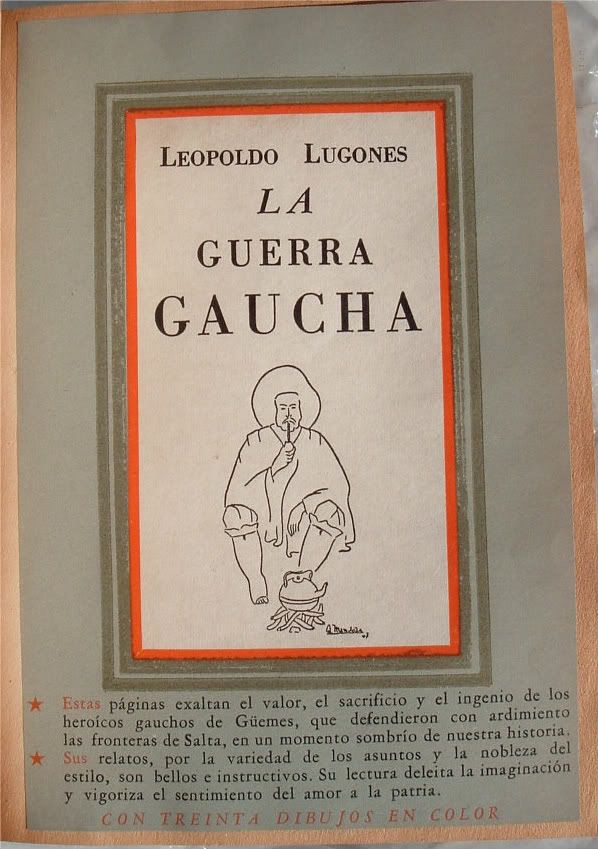
La Guerra Gaucha (19/81)


One dramatic footnote in the Argentine War of Independence took place in the northern provinces of Salta and Jujuy, where Spanish-led troops faced off with a guerrila force made up of local gauchos. Though not as strategically important as the campaigns of San Martín, Leopoldo Lugones found the confrontation between Spaniard and gaucho to be fertile ground for an exploration of courage, honor and patriotism. He travelled to the region to learn the oral traditions of the conflict and see the locations where the fighting had taken place.

Though he originally intended to write it as a novel, Lugones found that he could not work everything he wanted to say into one narrative, so La Guerra Gaucha became a collection of stories about the war. The short stories are to some extent disconnected: some feature skirmishes or battles while others feature the more day-to-day aspect of life during the war, and rarely does one get a sense of where each story fits into the larger strategic struggle.

The fighting, however, does serve as the binding force of the narrative. Even a simple local gathering can suddenly erupt into tense confrontation, and there are several stories in which the act of violence occurs suddenly, shockingly. The stories are also connected by several thematic elements, including the harshness of war, the desire for freedom, courage, sacrifice, fatalism.

The book does not want for fascinating characters--the friar who risks his life to signal the patriots, the gaucho who stages a suicide attack on a royalist fort, the young royalist lieutenant falling in love with a local widow--but Lugones' descriptive powers are effectively used to evocatively describe the land and its features. I never really considered Lugones a brilliant writer, as his other short story collections (Strange Forces, Fatal Stories) were longer on concept than linguistic fireworks. La Guerra Gaucha, on the other hand, reflects a sophisticated and striking command of language and imagery in service of the story he tells. Here he crafts a real sense of place to serve as powerful backdrop for the war being waged.

I will admit there were off moments, where Lugones' shades off into a simplistic nationalism. Perhaps these struck me as terrible in part because I was aware of his later embrace of fascism, but luckily there were very few of those moments. Overall, I'd have to call it the strongest of Lugones' short story collections.

(Sadly, this book does not appear to have ever been translated.)

Spin by Robert Charles Wilson (5/81)

Category: Hugo Award Winners (2/9)

Spin follows the lives of three friends, beginning when they are twelve and thirteen. The story is told by Tyler Dupree, and we follow what is happening to him in his "present" time, at the same time as he is telling us about his past. It makes for some very suspenseful reading.
Tyler's story of his past begins with the night the stars disappear. He is spending the evening with his two closest friends, the twins Jason and Diane. That October night begins what will later be referred to as the Spin. As the human race deals with this strange phenomenon, they make unsettling discoveries about what it means for Earth and its relationship with the rest of the universe. Because they discover that the Spin membrane (as it comes to be called) not only surrounds the Earth and blocks its view of the rest of the universe - it also effectively stops time for Earth. Each year on Earth is now equivalent to something like 100 million years in the universe, meaning that the sun is aging much faster relative to Earth, and within a few decades will destroy the Earth.
The glimpses we are given of the present, while hearing the history of the Spin from Tyler, make certain things in the story clear. But it leaves you wondering so much, so that you can't wait to get to that part of Tyler's history and find out what happened. I really was drawn into this book, and enjoyed it tremendously. Robert Charles Wilson will definitely be an author that I look for from now on.