Showing posts with label Buenos Aires. Show all posts

Thursday, April 30, 2009

The Tunnel (26/81)


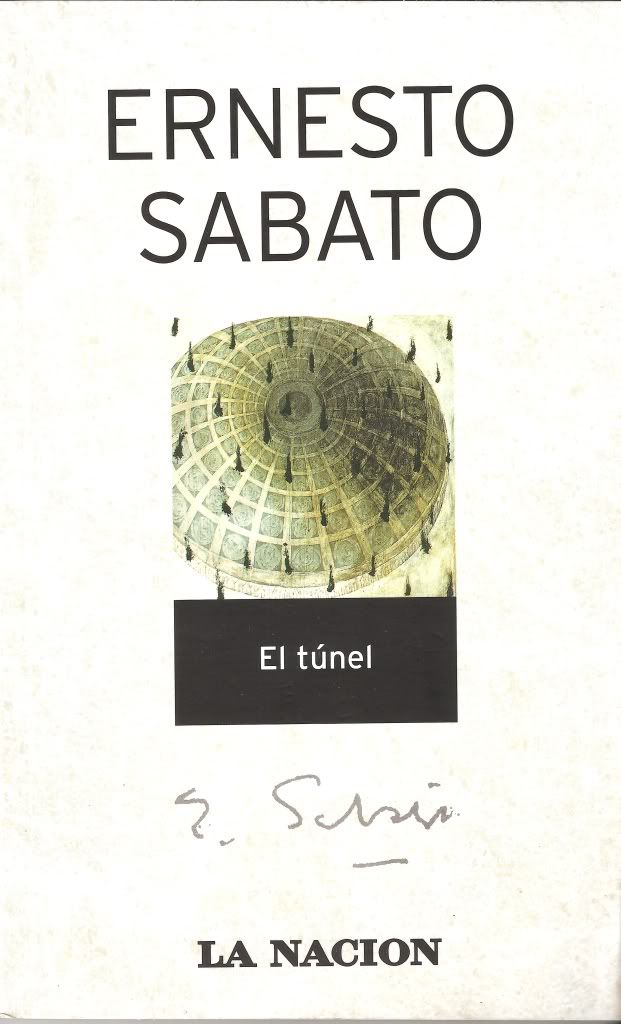
Ernesto Sabato's The Tunnel is the first person account of an artist's murder of the one person who understood him best. At an exhibition, Juan Pablo Castel notices a woman captivated by the window that takes up a small section of one of his finished paintings. She is the only person who appears to have realized the importance of the window, which leads to him becoming to become slowly and utterly fixated on her.

He seeks her out in a somewhat roundabout matter, finally running into her seemingly by accident. He learns that she has been thinking about his painting all the time since that showing. They become romantically involved, but Castel feels she is not being completely honest with him. He begins to suspect she has other lovers, perhaps even that he´s just a plaything to her. He becomes increasingly obsessed with possessing her until his actions cross over into derangement.

This is a novel about obsession and man's futile struggle for meaning, and it is no surprise that Camus found it important enough to have translated into French. I must admit I was not entirely captivated by the story. Though I'm fond of eccentrics in literature (especially the obsessive kind), I often found Castel's obsessiveness more irritating than contagious. I also felt the metaphor of the tunnel as reflecting the essential loneliness of human existence was a bit on the literal side.

So, overall an interesting look at one man's obsession and how it reflects modern man's fruitless search for connection, but not entirely satisfying.

Wednesday, April 29, 2009

The Tango Singer (24/81)

Bruno Cadogan is writing a dissertation on Borges' view of the tango--especially the older, less sentimental tangos Borges would have heard in his youth--when he hears that in Buenos Aires there is a man, Julio Martel, who sings the tango in this older style. Since no recordings exist of Martel's singing, Bruno heads to Buenos Aires to seek him out personally.

When he lands in Buenos Aires, he finds a room for rent in the very same building which housed Borges' Aleph in the story of the same name. From here he begins his quest for Martel, which turns into a labrynthine wandering through Buenos Aires in time and space. Martel, it turns out, has decided to forgo a career in order to use his tango singing to mark off places and events in the city that hold some particular meaning for him. He also becomes fascinated by the possibility of finding the Aleph in the house where he is staying.

This labrynthine wandering was the strongest aspect of the novel, and I really appreciated how Martinez explored and even celebrated the city of Buenos Aires and its lengthy and often tragic history. I cannot say if someone who has never visited the city would feel something similar, but I would certainly hope that the book would provide some motivation for planning a visit.

The novel did have a couple of flaws. Bruno Cadogan is meant to be an American, but he really thinks and acts more like an Argentine. While a minor flaw, it does cost the novel some verisimilitude. For me the larger flaw was that the novel was almost too Borgesian (never did I thought I would say that) in its use of allusions and homages to the point where it almost became distracting. (Bruno himself seems an obvious homage to Cortazar's "The Pursuer," also about a writer named Bruno fascinated with a troubled musician whose art allows him to experience time differently.)

Despite these flaws, I still found it a captivating read and greatly enjoyed its wanderings through the mazes of space and time which make up the reality of Buenos Aires.

Money to Burn (23/81)


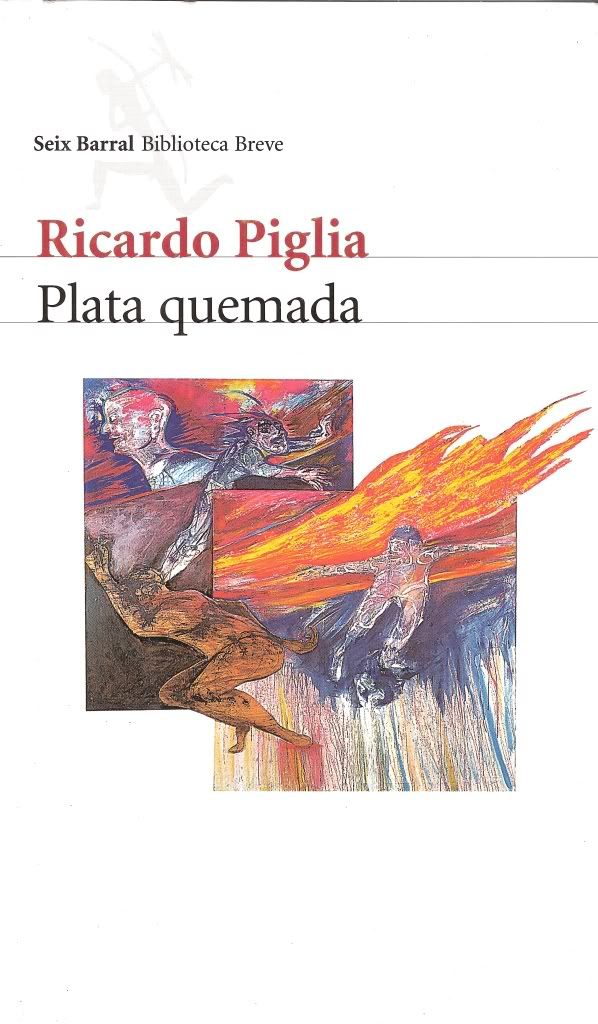
A group of Argentine criminals have got what could be a great heist planned out. They will grab the municipal payroll in a daring daytime robbery, then cross the river and slip into Uruguay until the heat dies down. The gang includes Gaucho Dorda and Nene Brignone, who are lovers; Cuervo Mereles, who swaggers with outlaw charisma; and Malito, a cold-blooded and calculating man and their defacto leader. The robbery goes off as planned, but they soon find themselves on the run, guns blazing as they drive their getaway car through the streets of Buenos Aires. Though the events related in Money to Burn seem outrageous enough to belong to a Tarantino film or a pulp crime novel, Ricardo Piglia as invented nothing in this hypnotizing tale of crime, loyalty and vengeance.

Piglia has a minor personal connection to the story, having met Mereles' ex-girlfriend in 1966 while on a train ride to Bolivia. During the trip, she told Piglia a confused and seemingly incredible story of the man she had been in a relationship with and the crimes he had been involved in. Though he never saw her again, he became fascinated by the story and began to research and attempt to write about it. It was a project that he ended up setting aside for the better part of two decades, only to return to and finish later.

Money to Burn is a novelistic retelling of true events, with Piglia acknowledging where the historical record is ambiguous or incomplete. The only license taken is in the extent to which we get inside the heads of those involved, not just the criminals but also the police who are hunting them. What emerges is a fascinating portrayal of criminality and politics in Argentina and Uruguay of the 1960s, as well as an unforgettable portrayal of characters far outside the pale.

Tuesday, April 28, 2009

Toda Mafalda (22/81)


Joaquín Salvador Lavado, aka Quino, is a cartoonist with a talent for observing the human condition and translating it into striking and darkly comic observations. Many of his works feature recognizable people in situations whose nightmarishness is made more painful by the truths so cleverly expressed. (It should come as no surprise that Quino's representations of bureaucracies at work bear some resemblance to Kafka's.) However, the comic strip Mafalda combines this dark comic sense with the more innocent realm of kids growing up in Argentina in the late 1960s.

If you are already familiar with Mafalda, Susanita, Manolito, Felipe and the rest of the gang, you probably need little convincing as to why Toda Mafalda, which features every Mafalda strip Quino ever created (including several for side projects or that were left out of previous collections) is a very good thing. (Sadly, the book is not in translation, though the individual collections have been published in English under the name Mafalda & Friends.)

Whenever I've tried to describe Mafalda to friends, I usually resort to describing it as "cross between Peanuts and Bloom County or Doonesbury." Like Peanuts, the principal characters are a group of kids with striking personality differences. (Though unlike Peanuts, the parents are also characters in the action.) But like Doonesbury and Bloom County, the comic deals with political and social topics of its time, including the Vietnam War and the crises affecting Argentina.

The appeal of Mafalda, though, is not in its topical commentary, much of which is dated or inaccessible to the non-Argentine. For one, as with Peanuts, the characters are quite memorable. There is, of course, Mafalda herself, a little girl more fixated on the problems of the world than adults around might find healthy. There is a certain poignancy to her, a sense that sometimes we feel a bit like children ourselves when faced with the complicated and seemingly unsolvable problems of the world. Mafalda has a perfect foil in Susanita, a superficial gossip girl who dreams of achieving status through marriage and motherhood. Her ambitions are something of a throwback, even for their time, but her fascination on the social realm and its secrets is still with us today.

I could go on, but I fear that my descriptions would not do the characters justice, nor Quino's often funny takes on politics, work, friendship, life and death. This is the kind of collection worth having on hand and revisiting quite often.

Saturday, April 25, 2009

The Mad Toy (21/81)

El Juguete Rabioso (usually translated as The Mad Toy), the debut novel of Roberto Arlt, was published with the help of Ricardo Güiraldes. It is arguably Arlt's most biographical work, chronicling the (mis)adventures of Silvio Drodman Astier as he attempts to find some way out of the poverty and alienation he has been born into.

Silvio is the parent of immigrants, an outsider in the world of early 20th Century Buenos Aires. He does not lack for ambition, though it often seems that the world works hard to thwart whatever minor dreams he may nurture. Because his father has abandoned the family, he finds himself having to quit school and seek work in order to support his mother and sister. At first he gets together with a couple of other neighborhood kids to engage in some theft, though their first crime--the break-in and robbery of a library--becomes their last after a close call with the police. Later, Silvio goes to work for a dishonest book seller, lands a job with the mechanic corps of the Air Force, and finally works as a paper salesman. The last of these turns out to be such drudgery, that he begins to consider returning to a life of crime.

Arlt expresses Silvio's drive, his hunger for success, in terms that must have been very familiar to him, as the changing circumstances move Silvio to alternate between hope and despair. The title is perhaps a little obvious in its metaphor: Silvio's overwhelming drives and passions combined with his inability to be enact them make him feel like some fierce frivolity. These different poles of existence are expressed in Arlt's unique prose, which combines lyricism with the street language of Buenos Aires.

The Mad Toy, as with most of Arlt's works, is a bracing, sometimes almost painful, work with moments of dark humor or fascinating inventiveness. It pales a bit in relation to Arlt's later The Seven Madmen (arguably his best work), in comparison with which it seems somewhat conventional, but if you've never read Arlt and are interested in encountering his unique representation of the alienation of modern life (Argentine style), The Mad Toy would be a good place to start.