Showing posts with label weird fiction. Show all posts

Saturday, June 27, 2009

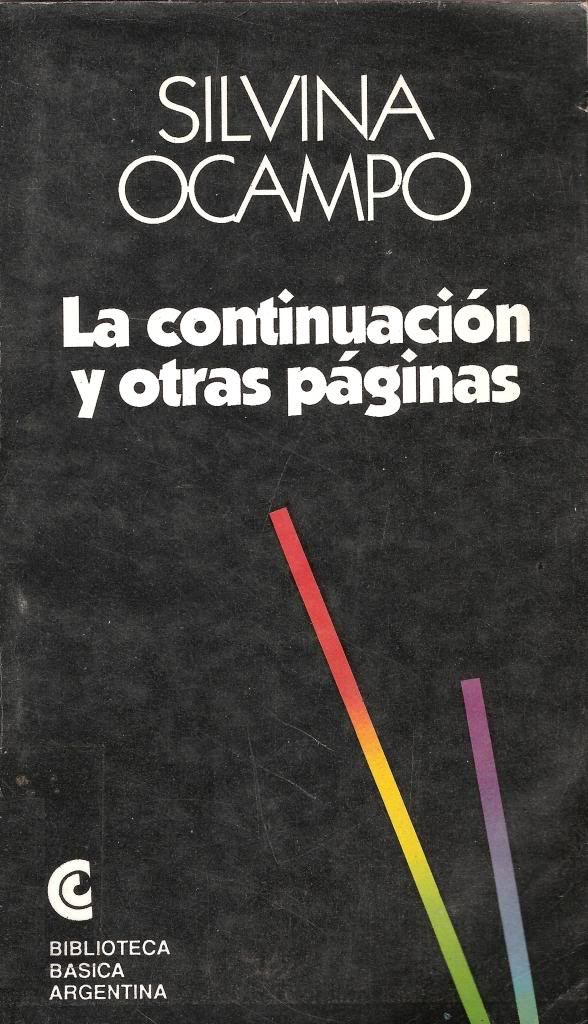
La continuacíon y otras páginas (29/81)


La continuacion is an anthology of stories and poems from Silvina Ocampo, who was friends with Borges, married to Adolfo Bioy Casares, and sister to Olivia Ocampo. In reading her short stories, I found it tempting to compare her to her contemporaries, Borges and also Julio Cortazar, which isn't entirely fair. Ocampo is certainly drawing from some of the same influences as those authors, but her perspective and style are clearly her own.

Among the themes are the blurring of identity (probably used most effectively in "La casa de azucar"), memories of childhood ("La siesta en el cedro"), and textual games ("Carta bajo la cama" and "El diario de la Porfiria Bernal"). Ocampo usually injects these themes with her own particular approach, as with the air of mystery and sadness that pervades the childhood stories. Of particular note is the sensuality of some of the stories, brining a certain liveliness to those elements. Admittedly, not all of the stories are great. (Of particular note is "El pecado mortal" for its oddly engaging take on the intersection of religion and sex.) Some of the later tales seem to have interesting concepts, though used in ways that struck me as less original.

Overall, a pretty nice collection presenting a sampling from the authors lifelong output.

Wednesday, February 4, 2009

Wicked by Gregory Maguire (14/81)

Wicked: The Life and Times of the Wicked Witch of the West by Gregory Maguire
Category: New-to-me authors

In this reworking of The Wizard of Oz, Maguire tells the history of Elphaba from birth to death. In between, we see her growing up years, school and friendship with Galinda, and her strong feelings about injustices in the world. The cast of characters includes a smorgasbord of humans, Animals (including a Goat who teaches at the school), and animals, as well as familiar characters like Dorothy, the Wicked Witches, and the Good Witch, each with a new twist. Maguire mixes serious moments, such as discussions about the existence of a soul or the nature of evil, and purely weird fantastical elements that left me wondering if this was something I really wanted to read.

I still don't know if I like the book, which is making it extremely hard to review. The tale is definitely unique, and includes moments that I liked and others I didn't. I'm not planning on reading this book again, but I'd try another book by this author. So, I'm giving it a rather ambivalent rating of 3 stars.

Cross posted on Born Reader.

Thursday, January 29, 2009

Sanatorium Under the Sign of the Hourglass (5/81)


It might be fair to say that this is the weaker of Schulz' two collections; that is, it is not 100% consistently mind-blowing. Perhaps only 90-98%. Schuz' prose has the quality of being downright intoxicating. His tales all deal with his family and life in his hometown, but the incandescent profusion of language and imagery reveals the transcendent behind the ordinary.

The first three stories feature an obsession with texts, starting with The Book of the story by that name, in which the Authentic is regenerated, and finishing with the strange season of "Spring," in which a stamp album holds the secrets to the Hapsburg dynasty and a youthful love triangle.

In the title story, the narrator visits his father at a convalescent home, where death is kept at bay through entrechment in the past. As the not-days progress, he soon learns that he is loving in recycled time.

"The Old Age Pensioner" and "Father's Last Escape" are haunting portrayals of the metamorphosis of old age and its approach to the final transmutation of death.

Schulz wrote like no one else, and his fantasies of the everyday are worth getting lost in.

Sunday, January 25, 2009

La Muerte y su Traje (3/81)


Santiago Dabove was a contemporary of Borges and, if JLB's introduction is any indication, something of an eccentric. He had little interest in publishing, and it was only the intervention of his more famous friend that managed to get this book edited and published after the author's death.

The stories here make for an interesting collection of strange stories, somewhat in the vein of Poe. The Poe influence shows up early, with the story "Ser Polvo" ("Being Dust") which seems to want to go Poe one better. While Poe was known to write about being buried alive, Ser Polvo describes a man being converted to earth while still conscious. It's a fascinatingly morbid work, rendered ambiguous by the narrators admission that he's dying and has taken large doses of heroine.

Another work which suggests Poe's "Facts in the Case of M. Valdemar", with a little Frankenstein (or Reanimator) thrown in for good measure, is "El experimento de Varinsky" ("Varinsky's Experiment) where a doctor uses a strange device to bring a man back from the dead, with strange results.

As you can see, death is a frequent theme in these stories, as one might expect from works influenced by Poe. Intriguingly, like Leopoldo Lugones or Macedonio Fernandez, Argentine authors publishing in this era, Dabove's work goes beyond copying Poe, incorporating philosophical or scientific elements to plum the uncanny in new ways, a process that would bear fruit with Borges himself.

It is an interesting mix of stories, if perhaps somewhat dark, but I found these little variations on the weird tale to be pretty entertaining.