Showing posts with label gaucho. Show all posts

Thursday, April 23, 2009

Don Segundo Sombra (20/81)

Don Segundo Sombra is the story of an orphaned boy named Fabio who has spent most of his early years in a small town living a somewhat rootless experience. One day he meets a gaucho named Don Segundo Sombra, the character who gives the novel its name, and is so impressed by the gaucho's quiet dignity that he decides to take him up as a mentor. He seeks out to the ranch of Sombra's current employer in order to obtain work alongside the gaucho. In the years that follow, he learns much from Sombra and travels widely around Argentina. The narrative details some of the adventures he encounters along the trail, including time spent among other gauchos.

Though there is some overlap, there is also a marked difference between the gaucho life as portrayed in Martin Fierro and that seen in this novel. Martin Fierro may have his honorable aspect, but he is basically an outlaw and a killer. While Sombra has its share of drawn knives, bloodshed is generally avoided. The one death that does result is portrayed as a tragedy and waste, without the outlaw romanticism of the older book.

What is most striking is the extent to which the gaucho is a civilizing influence. It is through Don Segundo that Fabio learns about courage, honesty and loyalty--values it is implied that he would not have picked up had he stayed with the distant relatives with whom he is staying at the beginning of the novel.

Like Martin Fierro, the novel's language draws heavily from Argentine, especially gaucho, manners of speaking, though written in a more natural and readable style. As with much gauchesque literature, the gaucho Sombra serves as symbolic of national character. Unlike those older works, Sombra was written when the real-life gauchos had begun to disappear and so reflects the shift of the gaucho from reality to myth, a lost emblem of the forging of personal and national adulthood.

Wednesday, April 22, 2009

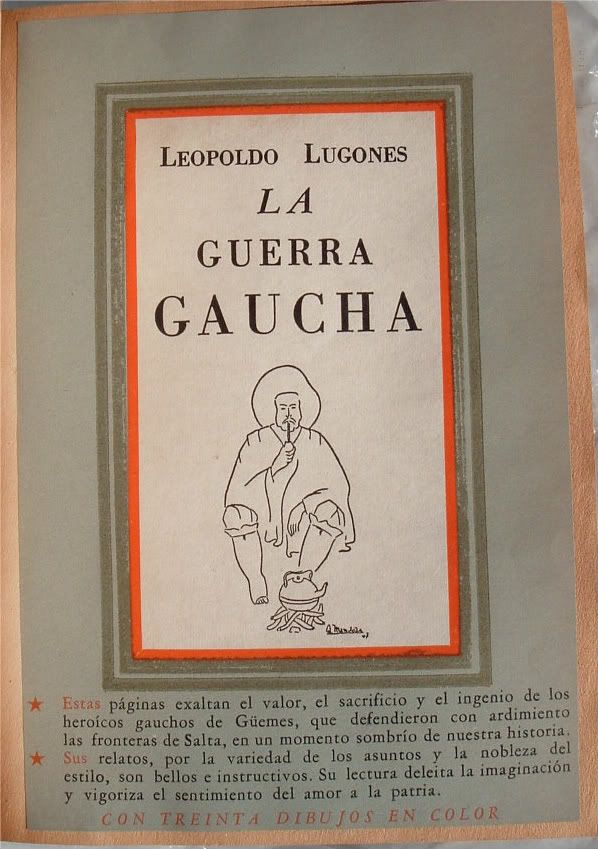
La Guerra Gaucha (19/81)


One dramatic footnote in the Argentine War of Independence took place in the northern provinces of Salta and Jujuy, where Spanish-led troops faced off with a guerrila force made up of local gauchos. Though not as strategically important as the campaigns of San Martín, Leopoldo Lugones found the confrontation between Spaniard and gaucho to be fertile ground for an exploration of courage, honor and patriotism. He travelled to the region to learn the oral traditions of the conflict and see the locations where the fighting had taken place.

Though he originally intended to write it as a novel, Lugones found that he could not work everything he wanted to say into one narrative, so La Guerra Gaucha became a collection of stories about the war. The short stories are to some extent disconnected: some feature skirmishes or battles while others feature the more day-to-day aspect of life during the war, and rarely does one get a sense of where each story fits into the larger strategic struggle.

The fighting, however, does serve as the binding force of the narrative. Even a simple local gathering can suddenly erupt into tense confrontation, and there are several stories in which the act of violence occurs suddenly, shockingly. The stories are also connected by several thematic elements, including the harshness of war, the desire for freedom, courage, sacrifice, fatalism.

The book does not want for fascinating characters--the friar who risks his life to signal the patriots, the gaucho who stages a suicide attack on a royalist fort, the young royalist lieutenant falling in love with a local widow--but Lugones' descriptive powers are effectively used to evocatively describe the land and its features. I never really considered Lugones a brilliant writer, as his other short story collections (Strange Forces, Fatal Stories) were longer on concept than linguistic fireworks. La Guerra Gaucha, on the other hand, reflects a sophisticated and striking command of language and imagery in service of the story he tells. Here he crafts a real sense of place to serve as powerful backdrop for the war being waged.

I will admit there were off moments, where Lugones' shades off into a simplistic nationalism. Perhaps these struck me as terrible in part because I was aware of his later embrace of fascism, but luckily there were very few of those moments. Overall, I'd have to call it the strongest of Lugones' short story collections.

(Sadly, this book does not appear to have ever been translated.)

Tuesday, April 21, 2009

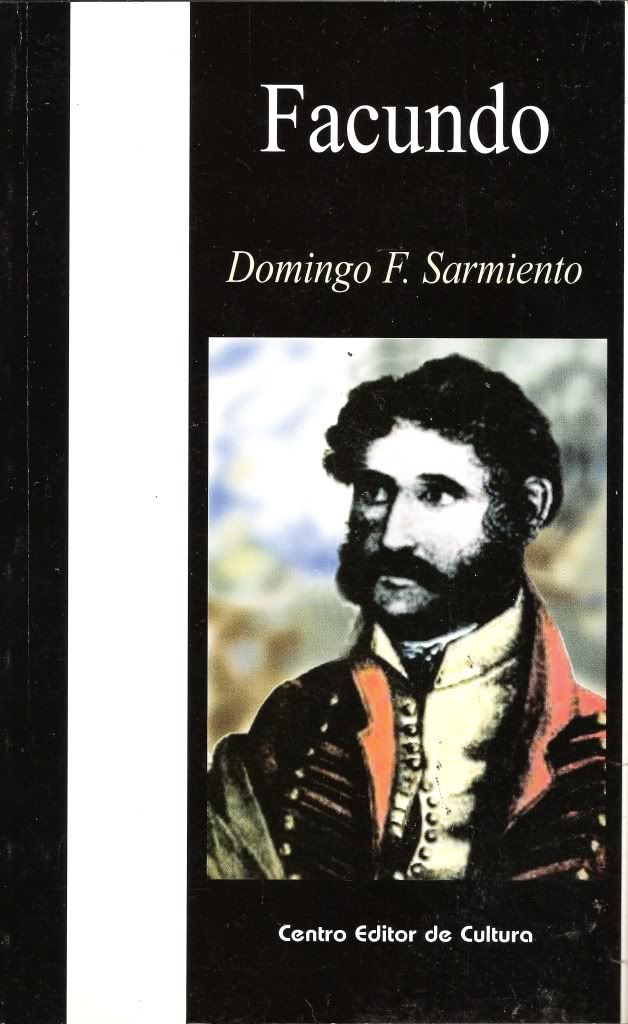
Facundo (18/81)

Domingo Sarmiento wrote Facundo while he was in exile in Chile, having had to flee Argentina due to Juan Manuel Rosas, the country's first dictator. Facundo can be read as his attempt to come to grips with the forces that brought his country under dictatorship and sent him to exile.

Facundo is presented as the biography of Facundo Quiroga, a gaucho and fighter in the War of Independence who would go on to serve as one of the most important generals in the civil war which would bring Rosas to power. Sarmiento uses the biography of Quiroga as a basis for a deeper exploration of Argentine politics and society. Even before Quiroga appears, Sarmiento gives a brief account of the geography of Argentina, and how its history led to a divergence between the city of Buenos Aires--cosmopolitan, cultured, with an interest in new political ideas--and the rural provinces, in which violence and corruption had come to dominate. In doing this, Sarmiento lays out the central struggle of Argentina as one between the Civilization of Buenos Aires and the Barbarism of the provincial caudillos, of which he sees Quiroga as an embodiment.

Quiroga makes for a larger than life figure, so there is a certain logic to his centrality (as opposed to Rosas) for Sarmiento. As a young man, Quiroga had a run in with a puma and killed it with a knife, earning the sobriquet "El Tigre de los Llanos" (The Tiger of the Plains). He dropped out of school while still young to pursue a gaucho existence buyt did not really make much of himself until becoming a leader of men during the civil war. Though not a great strategic thinker, his leadership of bands of gauchos turned out to be key in the victory of the Federalist forces under Rosas. Once Rosas is in power, Quiroga shows little interest in government, and ends up being violently assassinated. (Sarmiento alleges Rosas ordered the assassination, though the historical record is unclear.)

Quiroga can be thought of as many things: as novel, biography, history, and an exploration of the forces at work in Argentine history. Sarmiento sees the gaucho and his culture as expressions of the Barbarism which rejects the standards of Civilization. He advocates for the importance of education and the development of commerce in order to allow Argentina to rise to greatness. Though his theory of this struggle between Civilization and Barbarism tends at times towards simplification,(He seems to have a particular fetish for the use of European-style clothing as expression of political sophistication.) the difference between the European-influenced porteños and the insular world of the gauchos does bring insights into Argentina's history. Whatever its flaws, it's a fairly thorough and fascinating portrait of Argentina's internal struggle after independence and one very noteworthy figure in that struggle.

Monday, April 20, 2009

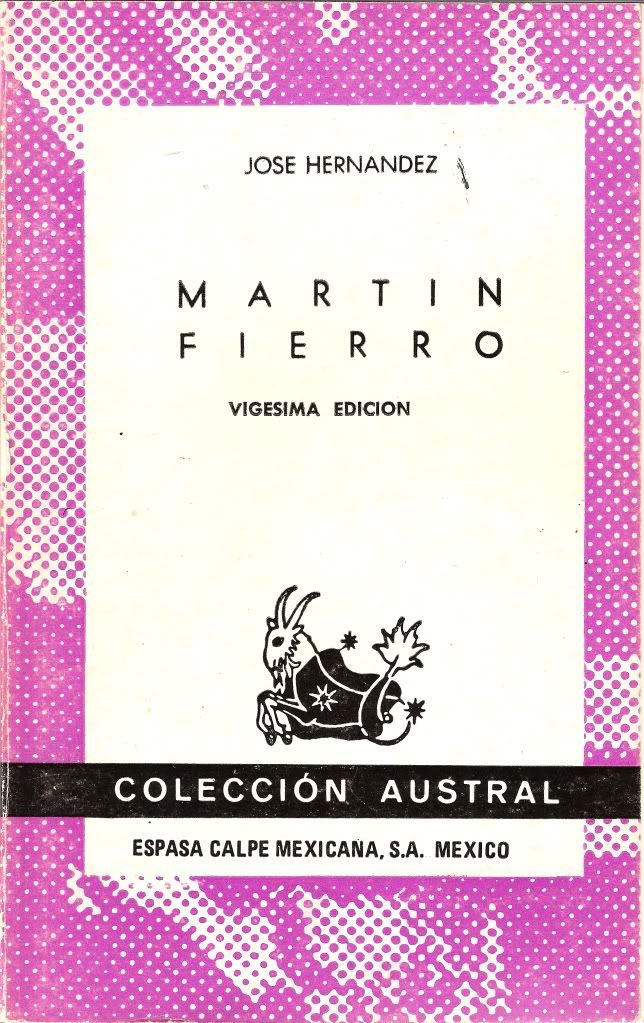
Martin Fierro (17/81)


Martin Fierro is a two-part epic poem about a nineteenth century gaucho of the same name. It belongs stylistically to a tradition of gauchesque poetry, written not in traditional Spanish but in a Spanish filtered through the language, wordplay and lyrical traditions of the rural life of Argentina.

The first part of the poem, "The Gaucho Martin Fierro" introduces us to the character of Fierro, a poor and uneducated, but basically decent gaucho who lives with his common-law wife and children and eeks out a a basic existence. Trouble begins when he is pressed into military service by the authorities (a common occurrence at the time) and sent to serve on the frontier with the "unsettled" lands ruled over by fierce tribes of Pampas and Araucans. Here he is underpaid, underfed, poorly supplied, and generally mistreated. When he sees an opportunity, he flees back to the world he left behind. Later, the authorities catch up to him, and his resistance reveals such a depth of courage and nobility that he finds an unlikely ally in this struggle. Together, the two friends travel beyond the bounds of civilization.

"The Return of Martin Fierro" picks up several years later, with Fierro having found life in the wilderness much harsher than he expected. He returns to his home, where he meets up with the sons--all grown up now--whom he had to leave behind ten years prior. Together, they share stories of hardship and struggle, and of dealing with corrupt and callous authorities. While Fierro finds that the authorities have forgotten about his outlaw status, one act of violence from his past returns to haunt him and to leave the narrative with an ambiguous ending.

Martin Fierro is a sympathetic protagonist, though not without his flaws. He is not just an outlaw and a deserter, but also a brawler and a killer, though he is not without his sense of nobility. When contrasted to the authorities, which exert such power over him yet care little for his welfare, it becomes only natural to feel for the gaucho. I found the combination of the outlaw mystique and the realism of the gaucho's social marginalization to make for a moving tale.

To add to this, Fierro is not only a noble outlaw but also a musician, making his role as archetypal figure all the more noteworthy. The narrative is presented as one in which each of the main characters tell his own story in song, and the combination of musical performance with outlaw machismo struck me as just as deeply embedded in North American culture, whether you're talking of cowboys or gangstas. The climax of the second part involves a "payado," a sort of traditional gaucho song duel in which two guitar-players/singers trade off improvising songs on a theme.

The use of gauchesque style and language make for something of a double-edged sword, providing a unique feel while being potentially difficult to fully grasp. The edition I read was bilingual and thoroughly footnoted, which I found to be very helpful. I managed to understand it pretty well while reading the original, with only occasional glances to the translation. If your Spanish, like mine, is good but could be better, I recommend a bilingual edition. If you're more of a beginner, you're probably better off sticking to a translation, though much of the texture of the gauchesque language will be lost.

Marin Fierro is considered among the first classics of Argentine literature, and as with many a book that I'd heard much about, I approached it with a certain sense of wariness, fearing age would have dimmed its power. However, with its portrayal of a heroic criminal confronted by corrupt authority, and its beautiful and unique language, Martin Fierro certainly earns its classic status.