Wednesday, April 22, 2009

Around the World in 80 Days

I pulled up a free copy on the Kindle and I’ve read it in between the more serious nonfiction sitting on my nightstand. I know I’ve read an abridged version but I don’t think I’ve ever read the entire work. I could relate to Passepartout seeking out an employer who could be consistent and dependable. Too bad his first day on the job turns out to be the day the dependable Phileas Fogg gets rash.

The cast of characters:

Phileas Fogg - a gentleman (when that word meant something) of unknown means, very regular in his actions with no time or energy wasted on superfluous activity or emotions. It is easy to believe he has no emotions - he is not excited or irritated by anything, but calmly takes the good and the bad, the beautiful and the mundane, and continues about his business without curiosity or urgency.

Passepartout - naturally good-spirited Frenchman, looking for a stable, reliable master where things are very well regulated. He is a perfect fit for Fogg. He is also, unfortunately, the direct or indirect cause of most of the delays. And he left the gas light in his room running when they left England.

Detective Fix - a policeman determined that Fogg is a bank robber and working hard to get Fogg and a warrant on English soil at the same time so he can arrest Fogg. He starts out by putting obstacles in their way while he could possibly arrest Fogg in India or Hong Kong (English colonies), and then by helping them to rush them back to English soil once they get into Japan and the United States.

Aouda is the Indian widow doomed to be burned to death on her husbands funeral bier until Fogg and Passepartout, along with an English colonel and a native rescue her. She can’t be left in India so she joins their party. She is indeed grateful to Fogg and he is very solicitous of her comfort.

Much is made about how Fogg seems to have no emotions and that is in direct contrast to the other members of the party who are excited by the sites, and depressed by the delays, and fret and worry over the bad luck they run into. I admire that Fogg sleeps calmly and is not disturbed by the things he cannot control. I do think more emotion along the positive side would be welcome. Not that he doesn’t feel it, perhaps, but he could certainly demonstrate a bit more. He is very solicitous of the feelings of others.

I still doubt they could get through the US without realizing they were a day ahead. If the ship left New York on time then it would have left a day before the day they expected (per his trusty schedule). I do understand not looking at any newpapers or otherwise seeing the date. Surely Fix was flooded with information after his embarassing false-arrest and he could have sent a telegram. But, the ending is good, even if it is convenient.

The Book of Chameleons by Jose Eduardo Agualusa (42/81)

Category: Themed Titles – Animals

I was drawn to this book because I’d heard about its unusual narrator – a gecko. The gecko observes the comings and goings from his vantage point on the wall of the house of Félix Ventura, an Albino who makes a living by faking histories and ancestors for prominent people.

The story is very much about identity with the chameleons of the title referring to all of the characters here. Even the gecko is not just a gecko as he remembers a past life when he was a man.

It was a surprisingly easy read, despite the unusual narrator, unfamiliar names and place, and descriptions of dreams.

Tuesday, April 21, 2009

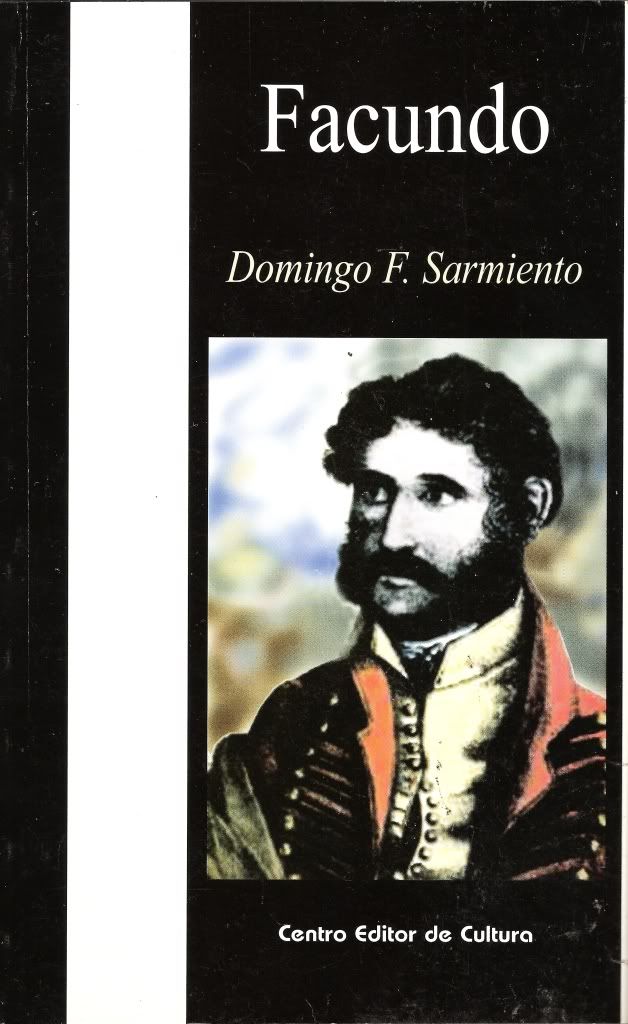
Facundo (18/81)

Domingo Sarmiento wrote Facundo while he was in exile in Chile, having had to flee Argentina due to Juan Manuel Rosas, the country's first dictator. Facundo can be read as his attempt to come to grips with the forces that brought his country under dictatorship and sent him to exile.

Facundo is presented as the biography of Facundo Quiroga, a gaucho and fighter in the War of Independence who would go on to serve as one of the most important generals in the civil war which would bring Rosas to power. Sarmiento uses the biography of Quiroga as a basis for a deeper exploration of Argentine politics and society. Even before Quiroga appears, Sarmiento gives a brief account of the geography of Argentina, and how its history led to a divergence between the city of Buenos Aires--cosmopolitan, cultured, with an interest in new political ideas--and the rural provinces, in which violence and corruption had come to dominate. In doing this, Sarmiento lays out the central struggle of Argentina as one between the Civilization of Buenos Aires and the Barbarism of the provincial caudillos, of which he sees Quiroga as an embodiment.

Quiroga makes for a larger than life figure, so there is a certain logic to his centrality (as opposed to Rosas) for Sarmiento. As a young man, Quiroga had a run in with a puma and killed it with a knife, earning the sobriquet "El Tigre de los Llanos" (The Tiger of the Plains). He dropped out of school while still young to pursue a gaucho existence buyt did not really make much of himself until becoming a leader of men during the civil war. Though not a great strategic thinker, his leadership of bands of gauchos turned out to be key in the victory of the Federalist forces under Rosas. Once Rosas is in power, Quiroga shows little interest in government, and ends up being violently assassinated. (Sarmiento alleges Rosas ordered the assassination, though the historical record is unclear.)

Quiroga can be thought of as many things: as novel, biography, history, and an exploration of the forces at work in Argentine history. Sarmiento sees the gaucho and his culture as expressions of the Barbarism which rejects the standards of Civilization. He advocates for the importance of education and the development of commerce in order to allow Argentina to rise to greatness. Though his theory of this struggle between Civilization and Barbarism tends at times towards simplification,(He seems to have a particular fetish for the use of European-style clothing as expression of political sophistication.) the difference between the European-influenced porteños and the insular world of the gauchos does bring insights into Argentina's history. Whatever its flaws, it's a fairly thorough and fascinating portrait of Argentina's internal struggle after independence and one very noteworthy figure in that struggle.

The Worst Hard Time by Timothy Egan (5/81)

Category: National Book Award for Non-Fiction (1/9)

The Worst Hard Time: The Story of Those Who Survived the Great American Dust Bowl was everything that I'd hoped for in a non-fiction title. Egan begins his tale by introducing us to many of the characters who will populate his history: real people who lived through the Dust Bowl in the No-Man's Land of the Oklahoma and Texas panhandles and the southeastern corner of Colorado, with some stories of northeast New Mexico and southern Kansas thrown in as well. The Dust Bowl is not a respecter of state lines.
The chronological story begins with the wheat boom that brought settlers to the plains. Egan tells us how they were lied to to get them to stay, and how they convinced themselves that agriculture could work on the land. It is tremendously sad, reading how the buffalo were destroyed and the Native Americans removed from their lands. Egan then goes on to describe the first changes, the beginning of the drought, when people did not yet know that disaster was coming. This is a profoundly moving book, as we get to know each of the families - you see how they suffer, how they stick through the worst times, or leave in order to save their lives. It's hard to imagine living through something so terrible, but I suppose that we always want to believe that it can't get any worse. This book is highly recommended for anyone who enjoys reading about history.

Monday, April 20, 2009

Martin Fierro (17/81)


Martin Fierro is a two-part epic poem about a nineteenth century gaucho of the same name. It belongs stylistically to a tradition of gauchesque poetry, written not in traditional Spanish but in a Spanish filtered through the language, wordplay and lyrical traditions of the rural life of Argentina.

The first part of the poem, "The Gaucho Martin Fierro" introduces us to the character of Fierro, a poor and uneducated, but basically decent gaucho who lives with his common-law wife and children and eeks out a a basic existence. Trouble begins when he is pressed into military service by the authorities (a common occurrence at the time) and sent to serve on the frontier with the "unsettled" lands ruled over by fierce tribes of Pampas and Araucans. Here he is underpaid, underfed, poorly supplied, and generally mistreated. When he sees an opportunity, he flees back to the world he left behind. Later, the authorities catch up to him, and his resistance reveals such a depth of courage and nobility that he finds an unlikely ally in this struggle. Together, the two friends travel beyond the bounds of civilization.

"The Return of Martin Fierro" picks up several years later, with Fierro having found life in the wilderness much harsher than he expected. He returns to his home, where he meets up with the sons--all grown up now--whom he had to leave behind ten years prior. Together, they share stories of hardship and struggle, and of dealing with corrupt and callous authorities. While Fierro finds that the authorities have forgotten about his outlaw status, one act of violence from his past returns to haunt him and to leave the narrative with an ambiguous ending.

Martin Fierro is a sympathetic protagonist, though not without his flaws. He is not just an outlaw and a deserter, but also a brawler and a killer, though he is not without his sense of nobility. When contrasted to the authorities, which exert such power over him yet care little for his welfare, it becomes only natural to feel for the gaucho. I found the combination of the outlaw mystique and the realism of the gaucho's social marginalization to make for a moving tale.

To add to this, Fierro is not only a noble outlaw but also a musician, making his role as archetypal figure all the more noteworthy. The narrative is presented as one in which each of the main characters tell his own story in song, and the combination of musical performance with outlaw machismo struck me as just as deeply embedded in North American culture, whether you're talking of cowboys or gangstas. The climax of the second part involves a "payado," a sort of traditional gaucho song duel in which two guitar-players/singers trade off improvising songs on a theme.

The use of gauchesque style and language make for something of a double-edged sword, providing a unique feel while being potentially difficult to fully grasp. The edition I read was bilingual and thoroughly footnoted, which I found to be very helpful. I managed to understand it pretty well while reading the original, with only occasional glances to the translation. If your Spanish, like mine, is good but could be better, I recommend a bilingual edition. If you're more of a beginner, you're probably better off sticking to a translation, though much of the texture of the gauchesque language will be lost.

Marin Fierro is considered among the first classics of Argentine literature, and as with many a book that I'd heard much about, I approached it with a certain sense of wariness, fearing age would have dimmed its power. However, with its portrayal of a heroic criminal confronted by corrupt authority, and its beautiful and unique language, Martin Fierro certainly earns its classic status.

The Thirteenth Tale by Diane Setterfield (41/81)

Category: New to Me Authors

I’d heard good things about this book but wasn’t particularly attracted to it, but when it was the monthly choice of my book club, I decided to give it a go.

Despite my misgivings, I was hooked from the first page. This is good old fashioned story telling. The plot is about an amateur biographer who is invited to hear the life story of a famous author, who has always fabricated elaborate stories about her background. What follows is a family saga, mixed with elements of ghost stories and references to classic literature such as The Woman in White and Jane Eyre.

It was a gripping story although the resolution was perhaps a little too neat and did require a leap of imagination to make it seem plausible. But that did seem entirely fitting for the style of the novel.

A great book to curl up with on winter's evening (although I read it in a sunny garden!)

Sunday, April 19, 2009

Generation X by Douglas Coupland, 8/81


This book was supposed to be the defining statement of a generation. That said, I enjoyed it less than some of Coupland's other work. This is the story of disaffected twenty-somethings who've found that life has little to offer them except escalating home prices, creeping commercialism, and what one can only describe as middle-class ennui. So, they escape to the desert, work minimum-wage jobs, and entertain one another telling stories. All of the stories highlight the emptiness that defines the characters' lives. I'm not entirely sure why I found this less fulfilling than other of Coupland's works. Perhaps it's because I was born at the tail end of Generation X, so these sentiments were hardly revolutionary to me. Perhaps the nearly twenty years that have passed since its first publication have seen the sentiments assimilated into mainstream culture (irony noted.) Whatever it is, I have enjoyed other of Coupland's works far more.
Douglas Coupland, Generation X (St. Martins, 1999) ISBN: 031205436X
Category: Canadian Fiction 2/9, 8/81