Wednesday, December 23, 2009

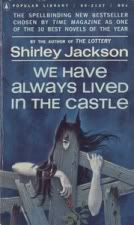
We Have Always Lived in the Castle (31/81)


The title of the novel is no accident, for it is as gothic a tale as any that was ever set in a crumbling castle on the banks of the Rhine. Its treatment of human evil, isolation and madness could easily qualify it as the pinnacle of 20th Century American Gothic.

A shadow has fallen across the house of Blackwood. Though once a prominent family, a possibly accidental poisoning has reduced their numbers to three (two sisters, an uncle) and made the townspeople suspicious of the survivors. The uncle, Julian, has been left physically crippled and one of the sisters, Constance, has developed a phobia about the world outside the house which does not prevent her from accepting visitors. It is left to the younger sister, Merikat (short for Mary Katherine), to venture into town on necessary errands.

Gothic literature often features singular characters, individuals who seem eerily plausible yet who are warped in a way that makes them unlike anyone else we've ever encountered. Merikat, who is the narrator and thus our guide through this story, is just such a character. It is clear that she views the townspeople with hostility, going so far as to craft charms--ordinary household items such as books or mirrors placed in odd locations or strange configurations--to keep the world at bay.

But soon it does intrude, in the figure of Charles, a cousin from an estranged branch of the family. His healthiness and level headedness seem to promise an opening up of the Blackwood home, a return to normality. But Merikat sees in him a representative of the crudity and selfishness of the outside world and seeks to drive him out through more and more powerful charms. The last of these results in a terrible reaction from the townspeople which sends the Blackwoods into greater isolation, leading to a hauntingly melancholy end to the story.

We Have Always Lived in the Castle is an incomparable achievement, a story that will equally charm and disturb in ways that sometimes can be almost intolerable. And you will probably never forget Merikat Blackwood.

Tuesday, November 10, 2009

Murder at Hazelmoor, 28/81


A murder in a tiny Dartmoor village in the dead of winter sets the stage for this classic Christie whodunit. Several had a motive, few had an opportunity. The most likely suspect is quickly imprisoned, but his fiance remains unsatisfied with the law's conclusions. Determined to clear James Pearson's name, Emily Trefusis sets off with intrepid newspaper reporter Charles Enderby to seek out the circumstances of Major Treveylan's murder. As with all of Christie's books, we get plenty of atmosphere as the plot unfolds in the Dartmoor countryside. Here we see the deepest depths of winter. This novel has all of the elements of a juicy, quick read. The plot and suspense build as we follow Emily on her quest for answers. This is classic Christie- a bit of brain-fluff, for sure, but engaging and well-written.


Agatha Christie, Murder at Hazelmoor (Putnam, 1987) ISBN: 0396090133


Category: Scary/Spooky, 3/9, 28/81

Easy to Kill, 27/81


It's easy to kill if no one suspects you, and in the situation Luke Fitzwilliam has wandered into, that seems to be the case. A series of deaths has mostly gone unnoticed-- unfortunate accidents, they seemed, but not to everyone. Lavinia Fullerton has suspicions and premonitions, but she is run down on her way to alert the authorities. After hearing Lavinia's story retired police office Luke Fitzwilliam decides to do a bit of investigating of his own. He finds a small town with a variety of eccentricities. In some ways, this novel follows the typical Christie pattern: murder, a variety of suspects, and an unsuspected conclusion. This particular Christie has more of an element of danger, however, which adds excitement. We actually get to see some action, not just the detective revealing his or her conclusions at the end. Christie has also been successful in underlining the fact that apparently, it is remarkably easy to kill (or at least it was in the days before DNA evidence and whatnot.)


Agatha Christie, Easy to Kill (Pocket Books, 1945) ISBN: 0671811282


Category: Scary/Spooky 2/9, 27/81

Wednesday, October 21, 2009

Velva Jean Learns to Drive, 26/81


In the mountains of western North Carolina, in the 1930s, Velva Jean Hart lives with her extended family in a community rich in folk tradition and seemingly isolated from the outside world. Velva Jean Dreams of one day going to Nashville to sing at the Grand Ole Opry. But Velva Jean's community is not one that people tend to leave. Velva Jean is limited by her age and family situation. With her mother dead and father run off, she is left to the restrictions of her older sister. With age and marriage Velva Jean's dreams of Nashville fade, but she gains a new desire- to learn to drive. This novel follows Velva Jean from childhood into young adulthood. At every turn it seems that Velva Jean is forced to push her dreams aside. Her story is set in Appalachia during the Depression, and we also see the first signs of outside intrusion into these previously cloistered communities. The Blue Ridge Parkway is about to be cut through the mountains. Even if it does not cut through their village, the new road will affect the lives of all around it. This was an engaging book, with a complex plot line and characters. A wonderful read.


Jennifer Niven, Velva Jean Learns to Drive (Plume, 2009) ISBN: 0452289459


Category: Published in 2009, 4/9, 26/81

Red Pottage, 25/81


This 1899 novel, the story of friends Rachel West and Hester Gresley, provides biting satire of the gender and class conventions that governed late-Victorian England. Set against a trio of painful love stories, Rachel and Hester learn the inconveniences and heartbreak of love. Rachel loves an adulterer, and Hester, a writer, loves her new book, whose manuscript consumes all of her time and energy. These pursuits are set against particular Victorian settings: Hester in the vicarage home of her self-satisfied, traditional, high-church brother, and Rachel in the stately homes of rural Middleshire's minor gentry. Both friends feel acutely the emotional and physical restrictions of their situation. None are able to understand Rachel and Hester's friendship, a deep, emotional attachment formed outside the boundaries of heterosexual marriage. Guiding the plot is what is perhaps one of the most ridiculous displays of masculine bravado: a suicide pact between the two lovers of Lady Newhaven. Cholmondeley is biting in her criticism of Victorian society. Somewhat different from other Victorian satirists, she relies upon plot rather than explanation. Cholmondeley doesn't tell us why we should see absurdity in a particular situation; she relies on plot to do that. Written at the very end of the Victorian era, we start to see the seeds of change in gender relations. The very biting quality of Cholmondeley's novel suggests coming change.

Mary Cholmondeley, Red Pottage, (Penguin, 1986) ISBN: 1406845612

Category: Virago Modern Classics 5/9, 25/81

Jewels: A Secret History, 24/81


I must admit, I am captivated by jewels: their shine, their brilliance, their color. Thus, I was excited to read a history of jewels. Finlay's is a social history, examining how human beings have constructed the value of brilliant minerals. This is not a comprehensive study. Finlay has chosen a series of case studies, the research for which took her all over the globe, from Australia, to Russia, to Sri Lanka, to the American southwest. This is quite an interesting book, and it certainly does show that these stones that human beings so treasure have no inherent value. This is evident in the changing fortunes of so many stones, which have variously fallen in and out of favor. It also becomes clear through the course of Finlay's work, that stones have, and do, cause a tremendous amount of human suffering. Indeed, in the long history of gems there has been much more misery than fortune. Finlay's history is clearly narrative in nature. She is concerned with telling some of the most interesting stories behind the jewels. It is not a book that analyzes the larger social forces behind many of these changes. Still, this is an interesting book. Finlay gained access to many places most people cannot. She travelled to some of the most unforgiving parts of the world in search of the people who mine, cut, and sell valuable stones. Any jewelry-lover will likely find this book engaging.

Victoria Finlay, Jewels: A Secret History (Random House, 2007), ISBN: 0345466950
Category: Reading the Dewey Decimal System, 2/9, 24/81

Monday, October 19, 2009

Arc of Justice: A saga of race, civil rights, and murder in the Jazz Age by Kevin Boyle (9/81)

Category: National Book Award for Nonfiction Winner (2/9)

Yes, it's true, I've only read 1/9 of the books for this challenge! I'm not planning on finishing, but I figure since I read a book for the challenge, I might as well post about it.
Arc of Justice is the story of Ossian Sweet and his family, and the murder trial they become involved in when the Sweet family attempts to move into a part of Detroit where they are not welcome. The Sweet family is black, and in 1920's Detroit, this means they cannot live where they choose, especially following the race-related violence of 1924 and 1925. When a mob gathers outside of their new home and begins throwing rocks and getting more and more violent, shots are fired, although by whom it is never fully clear. Dr. Sweet had filled his house with friends to help defend it from the violence he knew was coming. When one man in the mob dies after being shot from the house, the eleven people in the house, including Ossian's wife and two of his brothers, are taken into custody and eventually charged with murder.
This book is not just the story of the Sweet family and the trial, however. It is a story of race relations in the northern urban areas of America in the 1920's. Boyle does a tremendous job bringing all aspects of the story together to educate us on this issue. I am continually amazed by how little I know about the history of race relations in this country. This book is a must-read for anyone who wants to know more about our recent past.